Don't Buy the Opennms Until You Read This Full Analysis
Opennms (often seen as OpenNMS in the open-source community) is a mature network management and monitoring platform with a long history in the enterprise and carrier spaces. This analysis walks through what Opennms does well, where it struggles, how it compares to common alternatives, and the practical buying considerations organizations should weigh before committing to deployment or commercial support. The aim is to give a clear, practical view for network engineers, IT managers, and procurement teams considering a monitoring platform for production environments.
Introduction: Why this matters
Monitoring is the nervous system of modern IT operations. Selecting the wrong tool can lead to missed incidents, excessive engineering overhead, and rising operational cost. Buyers typically care about scalability, accuracy of alerts, integration capabilities, cost (both upfront and ongoing), and how quickly teams can derive value. Opennms promises a broad feature set: discovery, polling, event management, alarm correlation, topology mapping, and historical performance storage. Yet these promises come with trade-offs. This article evaluates those trade-offs against real-world use cases so decision-makers can make an informed choice.
What Opennms is, at a glance
Opennms is a full-stack network management system designed to discover, monitor, and manage devices and services across an infrastructure. It collects telemetry via SNMP, WMI, JMX, syslog, and various protocol checks, and it supports custom polling and thresholding for performance metrics. Architecturally it is built to handle very large deployments and supports distributed collectors and event forwarding, which makes it suitable for service providers and large enterprises with geographically dispersed assets.
Core capabilities
- Automated discovery and inventory of networked devices and services
- Polling and metric collection across SNMP, WMI, JMX, HTTP checks, and more
- Event management and alarm correlation to reduce noise
- Historical performance storage and graphing (supports different storage backends)
- Notification and escalation workflows with multiple channels
- APIs for integration with ticketing, CMDBs, and dashboards
Detailed product review and analysis
This section examines Opennms from the perspectives that matter most in real deployments: usability, scalability, feature completeness, extensibility, operational cost, and support options.
Usability and learning curve
Opennms is powerful but not trivial to learn. Configuration often involves editing XML or YAML-like configuration files, understanding provisioning rules, and tuning thresholding and event filters. For teams with strong network engineering skills and scripting expertise, Opennms provides a high degree of control. For smaller teams or organizations without dedicated monitoring engineers, the initial ramp-up can be steep.
Real-world implication: A university IT department looking to consolidate campus monitoring may find Opennms robust but should budget several weeks to months for configuration, discovery tuning, and false-positive reduction.
Scalability and performance
Opennms was designed for scale. Large service providers use it to manage tens of thousands of devices. It supports distributed collectors, which allows workload to be pushed closer to monitored assets and reduces network overhead. However, with scale comes the need for careful architecture planning: database sizing, storage backend selection for metrics, JVM tuning, and distributed event handling must all be planned and tested.
Key point: Out-of-the-box defaults will not suffice for very large deployments; capacity planning and performance testing are essential.
Alerting, event correlation, and noise reduction
One of Opennms’s strengths is its flexible event model. It supports event translation, correlation rules, and notification pipelines. When tuned effectively, it can significantly reduce alert noise and provide meaningful incidents for responders. That said, building effective correlation rules requires domain knowledge and iterative refinement.
Integration and extensibility
Opennms exposes APIs and supports custom collectors and integration with external systems (ticketing, CMDBs, dashboards). For organizations that need a single-pane-of-glass approach or integration with an existing observability stack, Opennms can be integrated with systems like Grafana, Prometheus (for metric collection/scraping synergy), or custom dashboards, though some integration work is typically required.
Looking for the best Electronics deals on Amazon?
Shop Amazon →UI and user experience
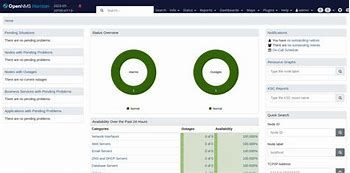
The UI provides topology views, event consoles, and graphs, but some users describe the interface as dated compared with newer observability UIs. Power users can live with that, but buyers that expect modern UX and rapid onboarding for non-specialists should consider this factor carefully.
Cost and support
The core platform is open-source, which reduces licensing cost, but total cost of ownership includes infrastructure, staff time, and optional commercial support contracts. Commercial support can be essential for mission-critical deployments to get timely fixes, upgrades, and operational guidance.
Pros & Cons
- Pros:
- Feature-rich and battle-tested in large-scale environments
- Strong event model and prescriptive correlation capability
- Broad protocol support (SNMP, JMX, WMI, syslog, etc.)
- Open-source core reduces vendor lock-in and licensing expense
- Scales well with distributed collectors and clustering patterns
- Cons:
- Steep learning curve for configuration and tuning
- User interface can feel dated to modern ops teams
- Requires careful capacity planning and JVM tuning at scale
- Integration to modern observability ecosystems requires work
- Documentation and examples exist but can be fragmented across versions
Comparison: Opennms vs. common alternatives
Depending on priorities, Opennms may be a good match or an overfit. The table below summarizes a practical comparison with three widely used alternatives: Zabbix, Nagios, and Prometheus. This high-level comparison focuses on typical buyer concerns.
| Feature / Tool | Opennms | Zabbix | Nagios Core | Prometheus |
|---|---|---|---|---|
| License | Open-source (community) with commercial support available | Open-source (GPL) | Open-source (GPL) | Open-source (Apache 2.0) |
| Best for | Large, mixed environments and carriers | Medium-to-large enterprise monitoring | Simple host/service checks and basic alerting | Metrics-focused cloud-native monitoring |
| Scalability | High (distributed collectors) | High (proxies, cluster) | Moderate (requires extensions for scale) | High for time-series metrics, less for event correlation |
| Metrics storage | Pluggable backends; legacy RRD options | Built-in TSDB | Not focused on long-term TSDB | Time-series DB model with Prometheus TSDB; excellent for metrics |
| Event correlation | Strong and flexible | Basic-to-moderate | Limited (plugins required) | Minimal (focus is metrics, external tools required for correlation) |
| Learning curve | Steep | Moderate | Low-to-moderate | Moderate (requires PromQL skill) |
Real-world use cases
Below are typical scenarios where organizations select Opennms and why:
- Telecom and ISP networks: Operators need stable discovery, event correlation, and distributed collectors. Opennms scales to thousands of devices and centralizes events from many sites.
- Large enterprise WAN monitoring: Global enterprises use Opennms to monitor branch routers, MPLS links, and service outages with custom alert pipelines.
- Data center infrastructure: For monitoring physical infrastructure and VMs across large estates where SNMP and JMX are important.
- Managed service providers: Teams that run monitoring as a service appreciate Opennms’s multi-tenant patterns and ability to federate collectors.
Buying guide: What teams should evaluate before choosing Opennms
This checklist helps buyers evaluate whether Opennms fits their needs and what questions to ask vendors, integrators, or internal teams.
1) Define scale and growth expectations
Estimate the number of devices, interfaces, and metric series today and in three years. If the count is in the thousands, plan for a distributed architecture and perform load testing to validate retention and query performance.
2) Identify required protocols and integrations
Make an itemized list of protocols (SNMP v2/v3, WMI, JMX, NetFlow, sFlow, syslog) and third-party systems (ticketing, CMDB, dashboarding). Verify Opennms supports each natively or determine integration effort.
3) Plan for data retention and storage
Decide on retention windows for performance metrics and events. Storage backend choice affects cost and maintenance. Confirm whether the organization prefers on-premise block storage, networked storage, or cloud object stores and how that maps to Opennms requirements.
4) Assess operational capabilities and staffing
Does the team have JVM and middleware experience? Will they manage upgrades and tune the system, or is commercial support required? Factor staff training and onboarding into the budget.
5) Trial and proof of concept (PoC)
Run a PoC with representative devices and traffic patterns. Measure discovery accuracy, alert fidelity, query latency, and false-positive rates. Use the PoC to refine provisioning rules and event correlation policies.
Shop the latest Electronics picks on Amazon.
See Deals →6) Support and maintenance model
Decide between community support versus commercial support contracts. Commercial packages typically include SLA-backed assistance, bug fixes, and upgrade help — critical for mission-critical systems.
7) Evaluate user workflows
Map out alert-to-resolution workflows. Can Opennms integrate smoothly with incident management, runbooks, and on-call rotations? Check whether notification templates and escalation chains meet operational needs.
8) Include security and compliance checks
Confirm the platform satisfies organizational security requirements: role-based access control, encryption for transport and at-rest data, and audit trails. If compliance with specific standards is required, document gaps and mitigation strategies.
Deployment patterns and best practices
Some practical recommendations based on deployments in large organizations:
- Start small with discovery and incremental onboarding of device classes to avoid alert storms.
- Use distributed collectors for remote sites to reduce WAN traffic and increase reliability.
- Invest time in developing event translation and correlation rules early — it pays off with much less noise.
- Automate provisioning where possible; integrate with CMDBs to reduce manual inventory drift.
- Schedule capacity testing and review JVM/heap tuning as part of operational runbooks.
When Opennms is the right choice — and when it is not
Opennms is right for organizations that need a feature-rich, scalable, protocol-diverse monitoring platform and have the staff or support budget to tune and operate it. It excels when event correlation and distributed collection are requirements.
It may not be the best fit when a team needs a lightweight, plug-and-play solution with minimal setup, or when the primary focus is metrics for ephemeral cloud-native workloads where Prometheus-style approaches provide faster time-to-value. For small teams without monitoring specialists, platforms with more turnkey UI-driven onboarding might be preferable.
Checklist for procurement conversations
- Ask for references of deployments at similar scale and use case.
- Request architecture diagrams for distributed setups and HA configurations.
- Clarify what is included in commercial support agreements (response times, escalation channels).
- Confirm upgrade and migration paths between versions and what downtime, if any, is expected.
- Validate logging, monitoring, and backup strategies for the Opennms stack itself.
Conclusion
Opennms is a robust, enterprise-grade monitoring system with deep capabilities in discovery, event management, and scalability. For organizations that need those capabilities and can invest in the necessary operational expertise — or who can purchase commercial support — Opennms can be an excellent core of a network operations toolchain. However, it is not a plug-and-play choice: the learning curve, integration tasks, and capacity planning are real costs of adoption.
Before deciding, teams should run a representative proof of concept, evaluate how Opennms will fit existing workflows, and compare the total cost of ownership (people, infrastructure, and support) against alternatives that might deliver faster time-to-value at smaller scale. With careful planning and the right resources, Opennms can be a powerful asset. Without that investment, buyers may encounter more friction than benefit.